Google Ads Not Bringing Sales? Audit the Account Before You Raise the Budget
A checklist an owner can start alone. It ends where most audits stop: at the sales recorded in the CRM.
From a Google bill you pay every month without knowing what came back, to a list of fixes ranked by what each one costs you.
Fixed-price package for online stores
Google Ads audit
SAR 500
Fixed price for one Google Ads account for one store
Delivered within 5 days of your order: about 48 hours after read access arrives.
Covers the last 90 days of data, with read-only access; nothing in your account changes.
Before you raise your Google Ads budget, let me read the account. I open it read-only and follow the money from the click to what the account calls a conversion, then to what actually reached your order log. Within about 48 hours you have a list of fixes ranked by what each one costs you, with the evidence from the account beside every item.
From my work: I've managed about USD 4M in Google Ads spend, cumulatively, on the HungerStation and LINE Live projects in 2018–2019, as project-based work through Kharabeesh.
SAR 500Fixed price for one Google Ads account for one store
Delivered within 5 days of your order: about 48 hours after read access arrives.
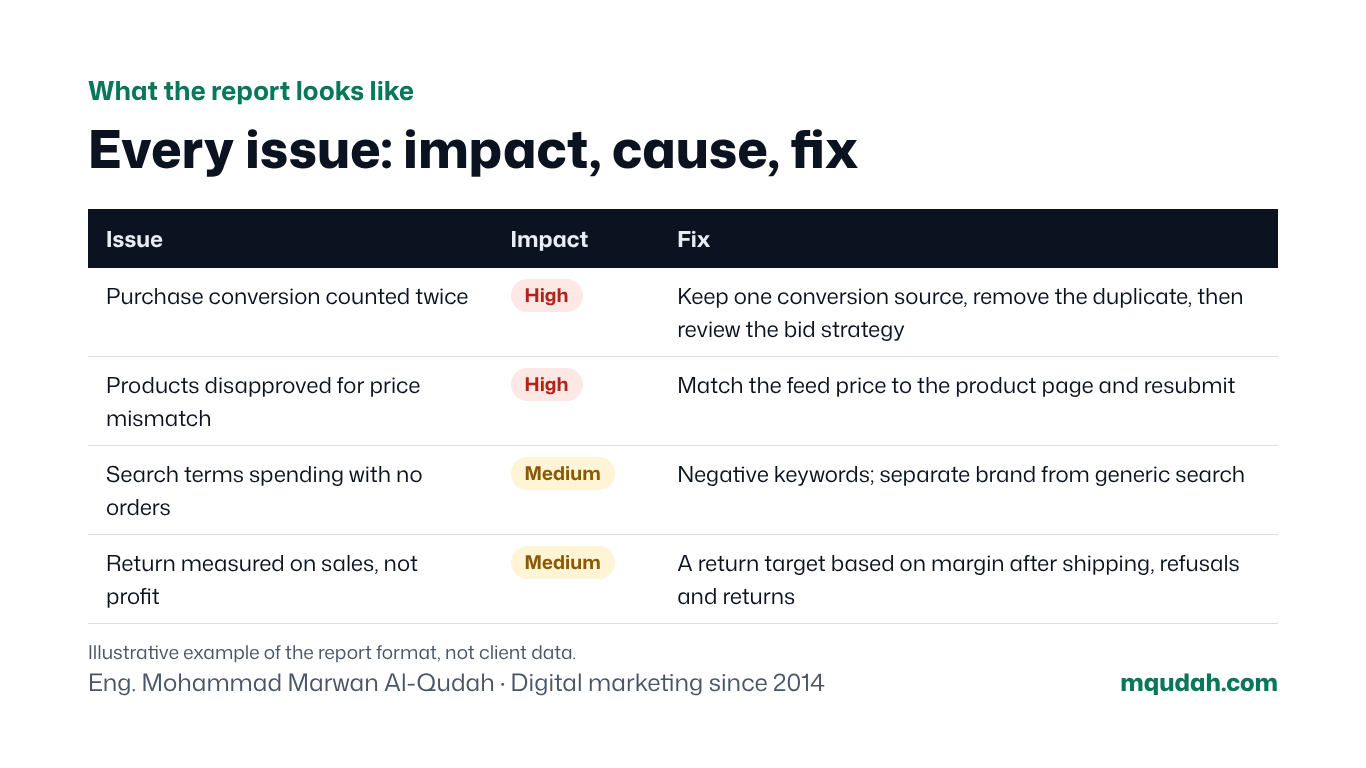
Before you ask how much to spend, ask what your account calls a conversion. Automated bidding learns from that definition, and if it's wrong, your budget gets spent very efficiently on the wrong thing.
The report says the campaigns work. The sales ledger doesn't say the same.
The agency is asking for more budget, and before saying yes, the manager wants a second opinion from someone who doesn't profit from the answer.
Campaigns bring form fills and taps on the WhatsApp button, and nobody knows how many became customers.
Most of the waste in a Google Ads account never shows up in the monthly report. It's written into settings nobody has opened since launch: a conversion that fires on a page visit instead of a payment, a default location setting that serves ads outside your market, search terms that have nothing to do with what you sell. Automated bidding doesn't know any of that. It learns from the conversion you give it, and if that's the wrong one, it gets very good at finding the wrong thing.
That's why I don't stop at the edge of the platform, as most audits do. Whatever Google Ads records as a conversion, I check against what reached your order log or CRM, especially when part of the sale closes on delivery or over WhatsApp. A falling cost per conversion is bad news for as long as those conversions don't become sales.
This audit is one part of the marketing and revenue audit, and it's the right choice when your doubt is about the Google Ads account alone. If the account comes back clean and sales are still weak, the wider audit picks up where this one stops.
I put the active conversion actions next to what you count as a result: a paid order, a qualified lead or a call. A tap on a WhatsApp button isn't a sale, and a cash-on-delivery order refused at the door stays a conversion unless someone adjusts it. Most waste starts here, because automated bidding learns from that definition.
The search terms report, not the keyword list. I add up the spend that went to searches unrelated to what you sell, in Arabic, in English and in the misspellings people really type, and hand you the missing negative keywords ready to add.
Can you raise budget on what pays and cut what loses, today? If campaigns, ad groups and match types overlap, the answer is no. I also check that brand campaigns sit apart, because they flatter the average and hide weakness everywhere else.
Its channel performance and search terms reports: where the spend goes, and how much of it reaches people who were already searching for your name. If that share is large, I recommend a brand exclusion.
The default location setting serves ads to people interested in your area, not only people in it. A store that delivers only inside Saudi Arabia can pay for clicks from outside it without anyone noticing.
I check that the bidding strategy suits the volume of conversion data and that the landing page keeps the ad's promise. Then I trace a sample of orders or leads in your records or CRM: did they arrive, and what happened next?
I've managed about USD 4M in Google Ads spend, cumulatively, on the HungerStation and LINE Live projects in 2018–2019, as project-based work through Kharabeesh. On HungerStation, food delivery in Saudi Arabia, the work was campaign management, conversion analysis, budget decisions and stakeholder reporting; on LINE Live, a live-streaming app launching in the Middle East, it was user acquisition, creative testing and forecasting. Accounts at that scale teach you that most waste never reaches the report; it sits in settings nobody revisited after launch.
Read-only is enough. It lets me see campaigns and run reports, not edit campaigns or billing, so nothing in your account changes during the audit. You remove it yourself after the walkthrough.
Yes, the access shows in the account's user list. I'd tell them before I start: the audit examines the account, not the person, and having them in the walkthrough cuts weeks off the fixes.
The clock starts when read access arrives. Large accounts, or an audit covering more than one account, take longer, and you hear that before I begin.
For an online store with one Google Ads account: a fixed SAR 500, with the details in the package above. For several accounts, or a company that sells by phone and CRM, the price depends on the number of accounts and the size of the campaigns, and you know it before you grant any access.
Then I'll say so. A clean account with weak sales is a useful finding: it means the problem sits before the ad or after it, in the offer or in how leads are answered and followed up. The marketing and revenue audit is the next step.
A checklist an owner can start alone. It ends where most audits stop: at the sales recorded in the CRM.
One Search campaign, one product, a purchase conversion you've tested and a budget you can carry for two weeks. That's the order I set up a store's first campaign in, and what I read at day 14.
A wrong search term isn't the odd-looking one; it's the one that never becomes a sale. How to find them in an Arabic account, and why plurals and synonyms each need a negative.
A one-week test an owner or marketing manager can run alone, to know which number to trust, which setting to fix, and what to ask the agency.
Google says the feature lifts offers from your landing pages into ads. An email to some advertisers, reported by Search Engine Roundtable, has it starting on 12 October 2026 unless you opt out.
From a Google bill you pay every month without knowing what came back, to a list of fixes ranked by what each one costs you.